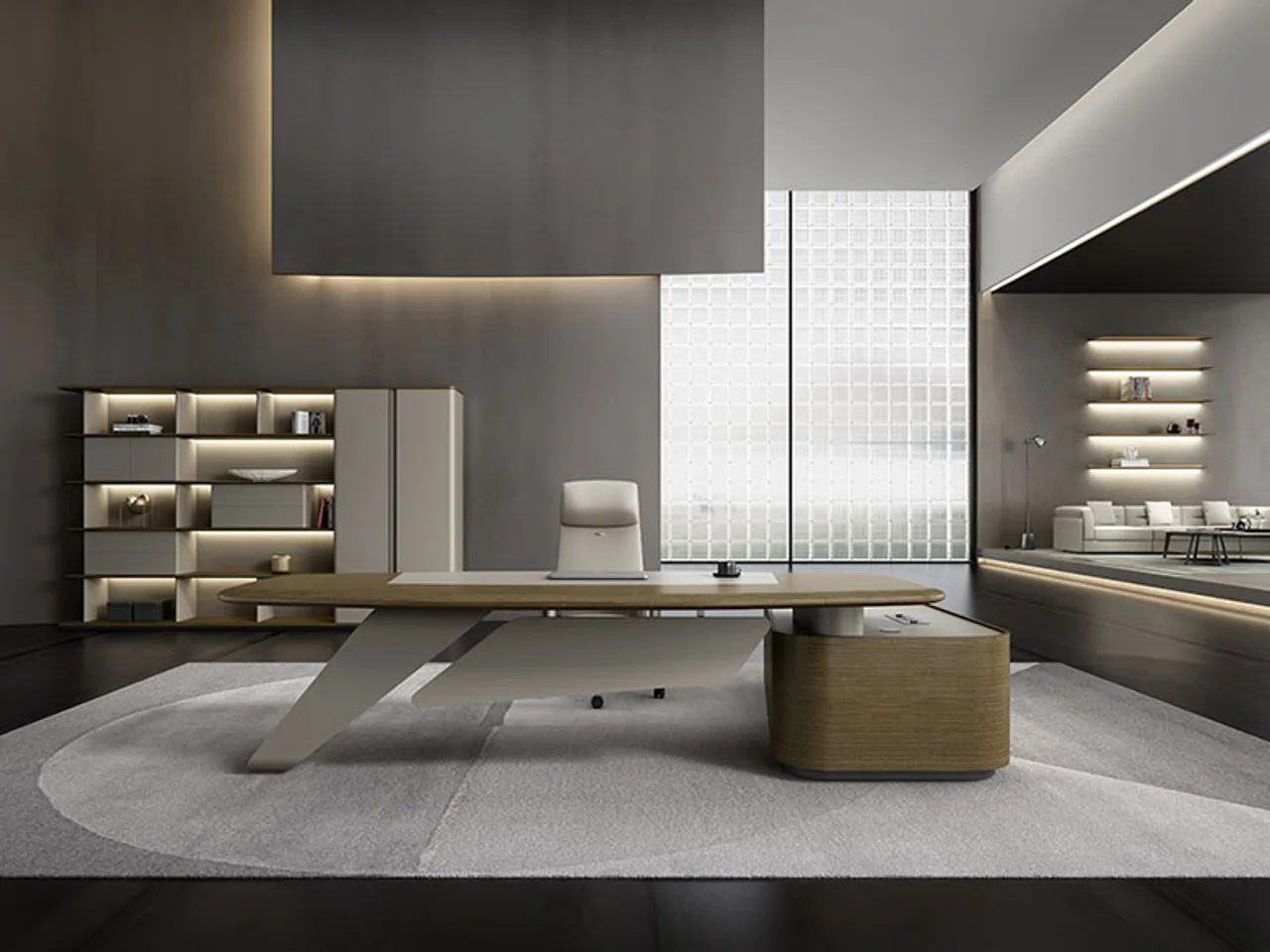
Buyers grill us on whether the chair is "BIFMA." Far fewer ask whether the desk passed a desk test — and a desk test is a completely separate standard from the chair one. A workstation that clears the chair standard tells you nothing about whether the frame, the top fixings or the storage survived their own tests. Here is the casegoods side, the part most sourcing guides skip.
The desk and casegoods family
In North America, office furniture other than seating has its own ANSI/BIFMA standards. X5.5 (current edition X5.5-2021) covers desk and table products — single and double-pedestal desks, extended units, credenzas and tables — running them through structural load, stability, durability and the cyclic abuse a desk actually sees. X5.9 covers storage units — pedestals, tambours, credenzas — including the stability and drawer-cycle tests that stop a loaded cabinet from tipping. X5.6 covers panel systems. These are distinct from X5.1, the chair standard. Asking "is it BIFMA?" without naming the part is like asking if a building "passed inspection" without saying which one.
The European side: EN 527
Europe puts desks under EN 527. Part 1 (EN 527-1:2011) sets the dimensions — including the worktable heights buyers feel: a fixed desk at 740 mm (±20), and height-adjustable frames spanning 650 to 850 mm to cover seated, sit-stand and standing work. Part 2 (EN 527-2:2016+A1:2019) sets safety, strength and durability requirements and the test methods behind them. A German or wider EU contract tender will often call up EN 527 by part number, and a desk that is structurally fine but sits outside the dimensional band can still be marked non-compliant.
Where they diverge — and what it costs
The two systems overlap in spirit: load it, cycle it, try to tip it, make sure it lasts. The divergence is in the dimensional bands and in exactly how each test is run, so a desk built carefully to one is usually close to the other but not automatically compliant with both. Here is the trade-off, the same one we put to chair buyers: building a single desk to clear both BIFMA X5.5 and EN 527 on every parameter is possible, but it means engineering the frame and fixings to the stricter of the two everywhere — and you pay for that even in the market that did not require it. If you only sell into the EU, building to a US dimensional band is money spent on a number your customer never reads. We would rather match the build to the destination. (For the equivalent comparison on seating, the BIFMA vs EN 1335 buyers' guide is a useful parallel read.)
Storage: the test that stops a tip-over
One part of the casegoods family deserves singling out, because it is a genuine safety issue, not just durability: storage stability. A tall filing or tambour unit loaded unevenly — every heavy drawer pulled out at once — can tip, and there are real injuries behind why X5.9 includes stability and drawer-interlock checks. For a contract order this is not a box-ticking exercise. If your project specifies tall storage, ask whether the units carry an anti-tip interlock (so only one drawer opens at a time) or are designed to be wall-fixed, and make sure the spec and the install plan agree on which. We build storage to the X5.9 / EN patterns and will tell you where a freestanding tall unit should really be anchored — because a tipped cabinet is the kind of failure that ends up in a lawyer's letter, not a warranty claim.
What report to actually ask for
"Send me the BIFMA report" is too vague to act on. A useful request names the standard and part (X5.5 for the desk, X5.9 for the storage, EN 527-2 for an EU desk), the configuration tested, and whether you need it on a representative sample or the production run. A report on a different size, base or top than you ordered is not evidence for your build — and an auditor or customs officer will treat it that way. We would rather agree the exact scope of the report up front than hand you a document that does not match what is in the container.
How we handle it
We build and bench-test our bench systems, executive desks and storage to the relevant BIFMA and EN patterns, and third-party reports — SGS, TÜV — can be arranged against your actual order. We do not pre-print a "certified" claim that may not match your final configuration, because a report on a different build is worthless at customs. Two practical asks before you order: name the destination market so we set the right standard and dimensional band from the first sample, not the third; and decide early whether your buyer needs the report on a representative sample or the production unit, because that changes the timeline. Our OEM / ODM workflow books testing into the sample stage so it overlaps production rather than tacking weeks onto the end.
If you are running a desk or storage programme across more than one region, send us the markets and quantities and we will map which standards apply and what building to both would cost. Reach the desk through our contact page or read the buyer FAQ.
Related: specifying a bench system and FSC and formaldehyde documentation.