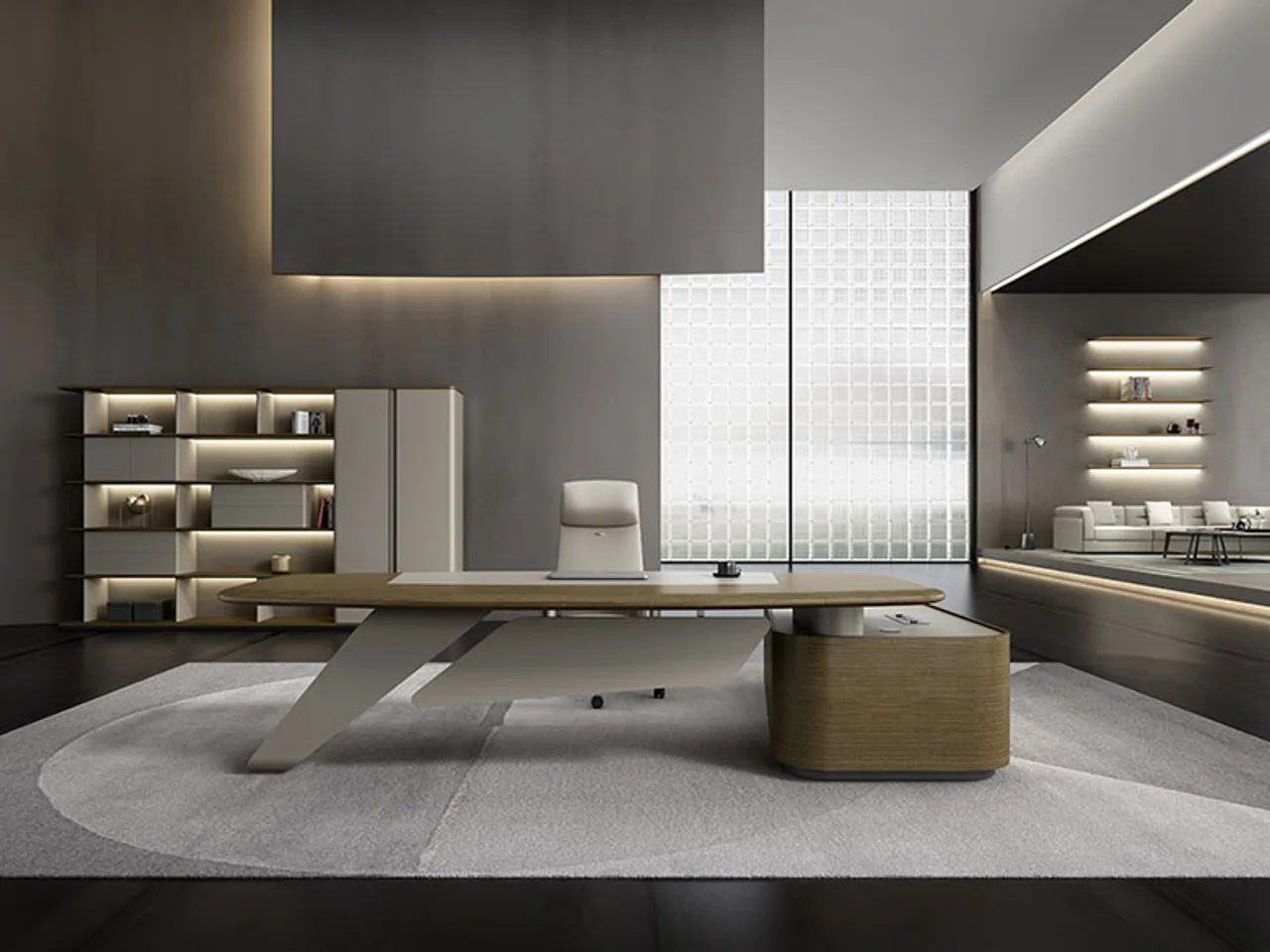
A bench system is the cheapest thing in an office to under-specify and the most expensive to replace. Two systems can render the same and quote 30% apart, and the gap is never the laminate colour — it is the frame gauge, the module and whether the standards behind it are named or implied. When a specifier sends us a layout, these are the lines we want filled in.
Dimensions: start from the body, then the floor
Bench widths cluster at 1200, 1400, 1600 and 1800 mm per person; depths run 600 to 800 mm. The honest defaults: 1400 mm wide and 700 mm deep is comfortable for one screen and a laptop; drop to 1200 mm only in a high-density or touchdown setting where people are not parked all day; go to 1600 mm for dual-monitor or technical roles. Bench depth — back-to-back — usually lands around 1200 to 1400 mm before the shared spine. Pick a width and stick to it across the floor; a single repeated module is what lets a 6-desk run become two 4-desk runs without re-buying.
On height, the European baseline is a fixed desk at 740 mm (±20), with height-adjustable frames spanning 650 to 850 mm. For shared open-plan we often suggest fixed-height to control cost and reserve sit-stand for assigned and executive positions — but we quote whatever the brief calls for and say where the money goes.
The component grid is the whole game
Here is the difference between a floor you can edit and one you re-buy. If the legs, beams, cable trays and storage are dimensioned to one module, re-planning a floor swaps tops and screens, not the system. If they are not, every change is a new order. So in the spec, ask the question directly: do a 1,400 mm bench and a 1,600 mm bench share legs, beams and cable trays? On a KANO system they do, by design. That single answer decides what a re-fit costs you in three years.
Name the standards, do not imply them
Desks have their own test standards, separate from the chair you sit on. In Europe, EN 527 covers office work tables — dimensions in part 1, and safety, strength and durability in part 2 (currently EN 527-2:2016+A1:2019). In North America the equivalent is ANSI/BIFMA X5.5 for desk and table products, with X5.9 covering storage units and X5.6 panel systems. A bench that clears the chair standard tells you nothing about whether the desk frame passed a desk test. We build and bench-test our frames to these EN and BIFMA patterns; third-party reports (for example SGS or TÜV) can be arranged tied to your actual order rather than pre-printed as a blanket claim.
Cable and power: the spec line everyone skips
The most common after-the-fact complaint on a bench programme is not the desk — it is the cabling. A bench that looked clean in the render arrives with no spine tray, no flip-top access and no way to get power from the floor box to the desktop without a trailing lead. Write the cable strategy into the spec: a shared beam tray along the spine, the access method (flip-top, grommet or under-desk basket), and how power gets from the building's floor or ceiling to each position. On a shared-desk floor this matters more, because people plug and unplug daily; a fiddly cable port is a daily irritation multiplied by every hot-desker. Decide cable before you decide colour.
Storage is part of the system, not an afterthought
Pedestals, tambour units and credenzas should come off the same module and finish library as the desks, not bought separately to "match." On a sharing floor, fixed under-desk pedestals fight desk-sharing — nobody wants someone else's drawers — so the honest move is to swap personal pedestals for shared lockers or caddies and free the desk to be truly shared. On an assigned floor, matched pedestals and credenzas are worth specifying together so the finish is identical, because a near-match in the same daylight looks worse than an honest contrast.
The trade-off: frame steel versus surface
When you compare two quotes, compare the steel and the edge, not the render. A lighter-gauge frame and thin edge-banding shave cost and show up two years later as wobble and chipped edges on a shared bench. A heavier frame costs more up front and disappears into the unit price over a system's life. We will tell you when a brief is over-built — a director-grade frame under a touchdown bench is money spent where nobody sits all day — and when it is under-built for the duty. Match the frame to the sharing ratio: harder-shared desks earn the heavier spec.
Putting it in the brief
A useful bench spec to send a supplier reads: width and depth per position, fixed or adjustable height, the component-grid question above, top material, cable strategy, storage type, and the test standard you need a report against. Send us that and a floor plan and we will quote it straight, flag anything over- or under-specified, and show how it packs into a 40HQ. Start through our contact page, or read how a full programme runs as OEM or ODM.
See also: the fit-out specification workflow and desk and casegoods testing explained.