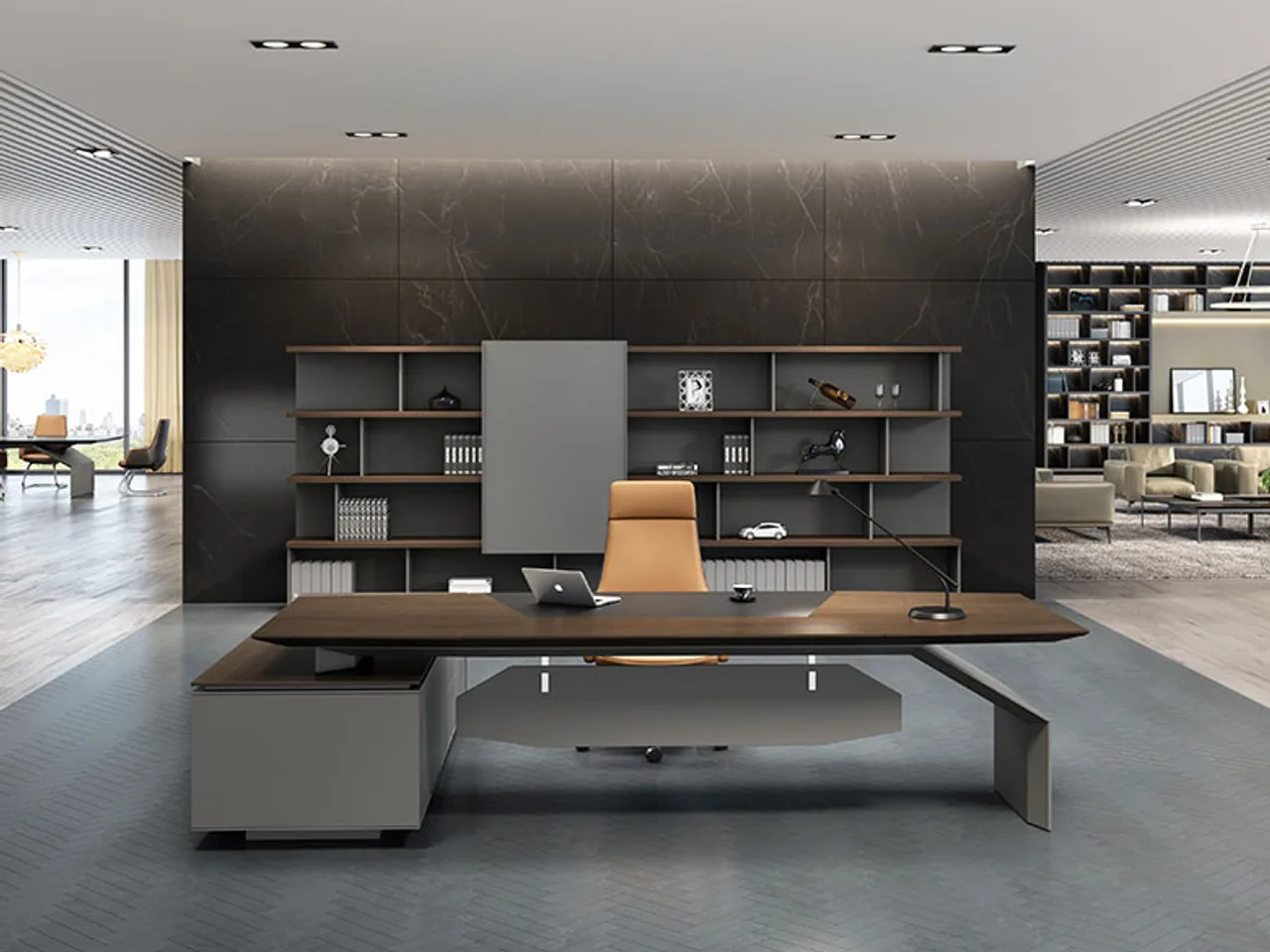
Every January the trend lists arrive: biophilic, resimercial, warm woods, wellness. They are not wrong, but a trend list does not tell you what to put on a drawing. We specify executive floors for a living, so here is what this year's vocabulary actually means once it has to be built — and where each idea earns its cost or does not.
"Resimercial" — residential warmth, commercial duty
The strongest current idea is resimercial: a private office or executive lounge that reads like a well-furnished home rather than a boardroom — softer seating, residential-style fabrics, lamps instead of only ceiling grids, a rug under the meeting table. It works because it lowers the temperature of difficult conversations and because, post-hybrid, an executive who can work anywhere wants a reason to be in this room. The trap is buying literally residential furniture for a commercial duty. A domestic sofa in a daily-use executive lounge sags within a year. We build the look on contract-grade soft seating — residential in feel, tested to commercial wear — because the room has to look considered for years, not just on handover day.
Biophilic — past the potted plant
Biophilic design is more than greenery, though the data on greenery is real: in one study of 7,600 workers, biophilic elements tracked with around 15% higher reported well-being and a few points of productivity. For furniture it shows up as natural materials and grain you can read — real-wood veneer on the desk, a stone or timber feature behind it, textiles with texture rather than flat synthetics. The honest caveat is durability: a delicate open-pore veneer that photographs beautifully also marks when a coffee cup sweats on it. We will steer a daily-use director desk toward a more forgiving finish — a tougher veneer, a sintered-stone top — and keep the most delicate timber for surfaces that get looked at more than used.
Warm, muted, natural — and matched
The palette has moved away from white-and-grey toward warm woods, muted earth tones and natural texture. The risk on a real project is not taste, it is matching: a reception wall, a director-floor veneer and a lounge banquette that are all "warm oak" from three suppliers will not actually match in the same daylight. Because our group also runs panel and residential-custom lines, our finish library is wider than a pure office maker's, which is precisely what lets the credenza, the wall and the seating come off coordinated finishes rather than three near-misses. On an executive floor, that match is most of the perceived quality.
The private office is shrinking — and working harder
The other shift worth planning for: the corner office is getting smaller and more multi-purpose. Fewer executives sit alone behind a vast desk all day; more use the room for one-to-ones, small huddles and focused work between meetings elsewhere in the building. That changes the furniture brief. Instead of one oversized desk and a wall of unused storage, the room often wants a moderate desk, a small meeting table or soft-seating corner, and discreet credenza storage that doubles as a serving surface. Drawing the suite on the same component grid as the floor means the room can be re-purposed — from a director's office to a shared meeting room — without ripping it out when the org chart moves.
Light, warmth and the things people actually feel
One detail that does more for a "premium" feel than any single piece of furniture: layered lighting. A floor lit only by an overhead grid reads as a call centre no matter how good the desk is; the same room with a task lamp, a low credenza light and a warmer colour temperature reads as considered. We cannot specify the lighting scheme for you, but we design executive and lounge pieces to sit with it — credenzas with a surface for a lamp, finishes chosen to look right under warm light rather than only under the showroom's cool LEDs. It is worth checking a veneer or stone sample under the actual room's lighting before sign-off, because a finish that glows under one colour temperature can go flat under another.
The trade-off behind every trend
The single tension running through all of it: the warmer and more residential a material looks, the more carefully it has to be specified for daily commercial use, and the more it costs to get right. A flat laminate is bullet-proof and a little cold; a soft-touch veneer is beautiful and needs the right room. The point of the executive floor is to look right for years — so we spend on finish where it is seen and touched, and pull back where it is not, then explain the jump rather than bury it. Modularity helps here too: an executive suite drawn on the same component grid as the floor outside it can be re-planned without re-buying when the org chart changes.
From trend to drawing
If you are designing an executive floor and want the trend to survive contact with a budget and a duty cycle, send us the brief — the look you are after, the daily use, and the finishes you want matched across the floor. We will tell you which materials hold up, which to save for show surfaces, and how to keep it all on one palette. Reach the planning desk through contact or read more on how we work.
See also: the desk-top finishes guide and open-office acoustics.