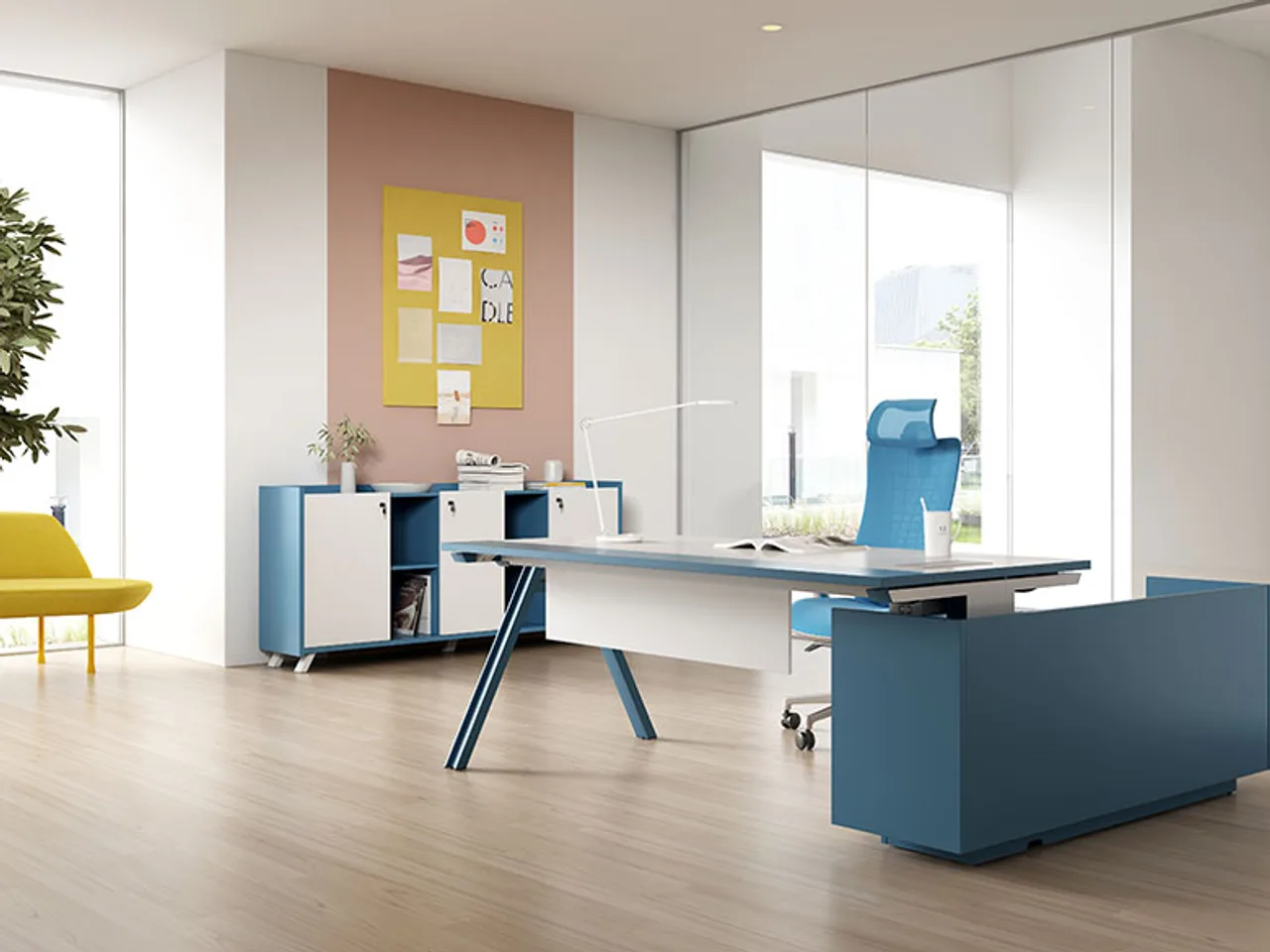
An office fit-out is a relay, not a single order, and the furniture is one leg of it. When a project goes wrong on furniture, it is rarely the desk that failed — it is that the factory was brought in at the wrong step, after decisions were locked that should have been tested first. For architects, designers and dealers running a furniture package, here is the sequence as we see it from the production end, and where we are genuinely useful.
The steps, in order
A typical furniture package runs: design and layout (the A&D team sets the plan, the zones, the look) → specification (each item written down — dimensions, materials, finishes, performance) → FF&E schedule (Furniture, Fixtures & Equipment costed and procured) → sampling and approval → production → delivery and install. The FF&E process generally kicks off around the halfway mark of design — roughly the 50% submittal — not at the end, because furniture dimensions feed back into power, data and the layout itself.
Specification is where the money is decided
The spec is the contract with reality. A loose spec — "executive desk, wood, approx. 2000 mm" — invites three suppliers to quote three different things, and the cheapest one wins on a board you would not have chosen. A tight spec names the top material, the frame, the edge, the standard to test against and the finish reference. This is the step where bringing a maker in early pays for itself: we can tell you, before it is locked, whether a specified finish suits the duty, whether a dimension fights the component grid, and what a small change would save across the whole system.
Sampling: the step you cannot skip on a real project
For a programme that repeats across a floor or a container, a render approval is not enough. We build a physical sample of the key pieces — the bench, the director desk, the credenza — and the specifier signs off on finish, edge, hardware and fit before we cut production. It feels slow. It is far cheaper than discovering a finish mismatch on a full container, and it is the moment a drawing becomes a buildable spec. We treat this as non-negotiable on a repeating order, and we would rather slow down here than re-make a floor.
The trade-off: dealer in the middle, or factory direct
Two routes reach the same floor. Going through a dealer gives you local accountability, install labour and a single throat to choke on site — and it costs a margin. Going factory-direct on an export project trims that margin and gets you closer to the people who actually build it, but you carry more of the coordination — customs, last-mile, install crew — yourself. Neither is wrong; they are different bets on where you want the risk. We work both ways: as the OEM behind a dealer or contract brand, and direct with developers and end clients who have their own install capacity. We will be straight about which suits your project rather than pushing the one that suits us.
The detail that saves the install day
The last leg is where good factories separate themselves. A container that arrives as an undifferentiated wall of cartons turns install into a treasure hunt. We label cartons in install order and by zone, so the crew unloads reception first, then the open plan, then the executive floor — the box you need is near the door when you need it. On a fit-out with a hard handover date, that labelling is worth more than a small price difference.
Build the timeline backwards from the handover date
Furniture is usually on the critical path near the end of a fit-out, and the mistake we see most is treating production and shipping as an afterthought once construction slips. On an export project the calendar is unforgiving: production runs weeks, the sample-approval loop adds its own time, and sea freight from China to Europe or North America is measured in weeks at sea on top of that. Work the timeline backwards from the install date — handover, minus install days, minus transit, minus production, minus sampling — and you usually find the furniture order needed to be placed earlier than anyone planned. We give a real stage-by-stage timeline per project rather than a single number, precisely so a slipping construction date does not quietly eat the furniture lead time and blow the handover.
Snagging and the handover that sticks
The relay does not end when the container is unloaded. A good install closes with a snag list — the walkthrough where the design team marks anything damaged, mismatched or missing, and it gets resolved before sign-off. Two things make that go smoothly: spares (we ship a small percentage of consumable parts — caps, glides, keys — so a single transit scuff does not hold up a whole floor) and clear documentation of what was ordered against what arrived. A fit-out remembered as "good" is almost always one where the last 5% — the snags — was handled without drama, not one where the desks were marginally cheaper.
Where to bring us in
The short version: involve the maker at specification, not at purchase order. Send us the layout and the draft FF&E schedule while it is still editable, and we will sanity-check the spec, sample early, and plan the load and labelling around your install date. Start the conversation through our contact page, or see the full OEM / ODM process.
Related: sustainability documentation for the FF&E schedule and how to specify the bench system.