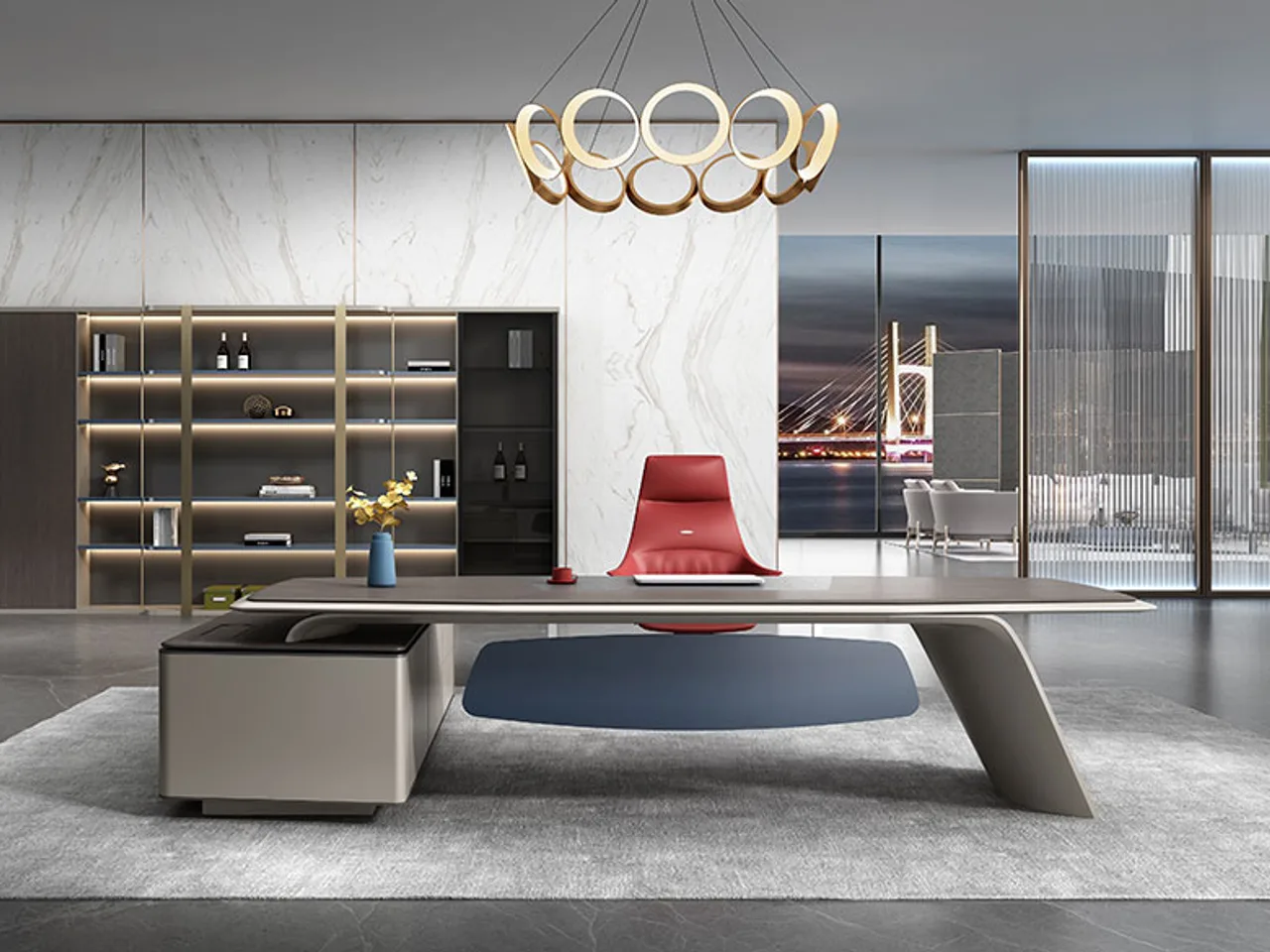
The top is the one part of a desk a buyer looks at closely, and the part a price-driven quote quietly downgrades, because the difference does not show on day one. "Wood-look" can mean a tough laminate or a delicate veneer that cost five times as much. So when we quote a system or an executive range, the top material is one of the first things we pin down, not the last. Four materials cover almost every office.
Melamine / TFL — the value workhorse
Thermally fused laminate — what most people call melamine — is a decor paper fused to a board core. It is the right, honest default for hard-working open-plan desking: scratch- and stain-resistant enough for daily use, available in dozens of wood and solid decors, and the most cost-effective surface on the floor. Its limit is impact and edge wear — it is less tough than HPL and a sharp knock can chip an edge. For value-led open plan where the duty is normal desk work, melamine on an engineered frame is the choice we make without apology. We quote it as E1 (low-formaldehyde) board as standard.
HPL — when the surface takes a beating
High-pressure laminate is built up under far higher pressure into a denser, tougher sheet, then bonded to a core. On the lab and field comparisons it is the most durable of the laminates for horizontal wear surfaces — better scratch, wear and impact resistance than TFL. It costs more, and it earns it on the desks that get punished: hot-desked and shared benches, training tables, reception counters, anything touched by many hands all day. If a top is going to be abused, HPL is where the extra spend actually returns.
Veneer — real wood, real care
Real-wood veneer is a thin slice of actual timber over a stable core, and nothing laminate-printed quite matches the depth of real grain in daylight. It belongs on director and chairman desks and the surfaces an executive floor is judged on. The trade-off is honest and worth repeating: of the four, veneer shows water and wear most readily — a sweating glass left overnight can leave a ring. We run it where it is admired more than abused, and we will tell a client when a daily-use, shared surface is the wrong place for delicate veneer.
Sintered stone — the durable statement top
Sintered stone (and high-quality stone-look surfaces) gives an executive or meeting top that takes daily coffee, laptops and heat without marking, with a presence laminate cannot fake. It is the heaviest and usually the priciest option, which matters for both the base spec under it and the freight. We reserve it for meeting tables and executive desks where the surface is in daily contact and has to look unbothered for years — exactly the spot where veneer would struggle.
The edge and the core decide how long a top lasts
Buyers compare the surface and forget the two things that actually fail first: the edge and the core under it. On melamine and HPL, the edge is where chips start — a cheap iron-on PVC edge lifts and chips at the corners, while a properly applied laser- or PUR-bonded edge holds for years. Ask what edge is on the quote, not just what the face is. The core matters too: a top is only as flat and as stable as the particleboard or MDF beneath the decor, and a thin or low-density core sags over a long span or swells if it ever meets moisture. On worktops that span an unsupported width — a long reception counter, a meeting table — the core spec is the difference between a flat surface in three years and a visible bow. We quote the edge and core, not just the colour, because that is where a cheap top hides its corners cut.
The cost order, plainly
Roughly, from least to most expensive surface: melamine, then HPL, then real-wood veneer, then sintered stone — though a premium veneer can overtake stone depending on the timber. The useful point is that the gaps are large enough that material choice, not supplier haggling, is what moves a furniture budget. If you give us a target cost per workstation, we work backwards: melamine across the open plan, HPL on the abused surfaces, and the spend concentrated on the executive and meeting pieces where veneer or stone is seen and touched. That is a deliberate allocation, not a compromise — money on the surfaces that earn it, and an honest laminate everywhere a delicate top would just get scarred.
The rule we actually use
Match the surface to the duty, not to the render. Melamine for value open plan; HPL where the desk takes a beating; veneer where it is admired; stone where it must shrug off daily use and still look the part. The mistake we see most is a beautiful veneer specified across a whole floor "for consistency," then half of it scarred within a year on the shared desks. Consistency comes from a coordinated finish palette across materials — which our wider panel library makes possible — not from forcing one delicate material everywhere. Tell us the room and the duty and we will name the top, in writing, with its trade-off.
Send your layout and how each zone gets used, and we will spec tops per zone and quote the deltas so you can see exactly what the finish choice costs. Start at our contact page, or read how the range shares one grid and one finish library.
Related: FSC and low-formaldehyde boards and executive design trends.