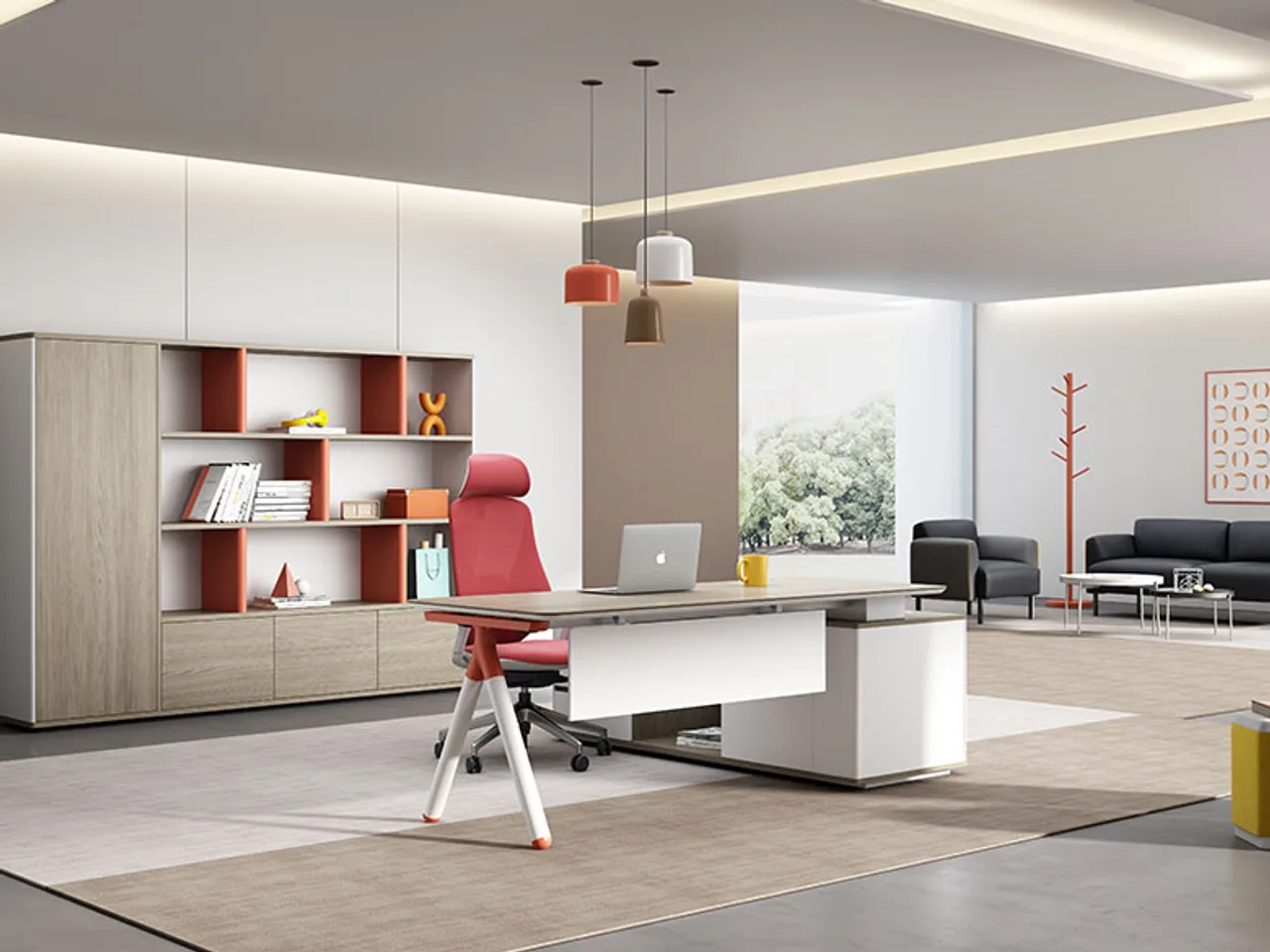
"Can you make the open plan quieter?" comes up on most fit-out briefs, and the honest answer is: partly. Acoustic comfort in an open office is set by the building, the layout and the furniture together — and of the three, furniture is the lever we control and also the weakest on its own. We would rather say that plainly than sell you screens as a cure.
The ABCs — and where furniture sits
Acousticians describe open-plan sound control with three letters: Absorb, Block, Cover. Absorb takes energy out of the room — ceiling baffles, soft flooring, upholstered seating, acoustic panels. Block puts mass in the path of sound — screens, storage, pods, partitions. Cover adds a low, steady background sound (sound masking) so a nearby voice stops being intelligible. Furniture lives mostly in the first two: a tall enough bench screen, an upholstered banquette, a storage credenza used as a low wall. What furniture cannot do is the Cover part — that is an electroacoustic system, and a good acoustician will specify it alongside the furniture, not instead of it.
The metric: distraction distance
The number that actually measures this is from ISO 3382-3: distraction distance. It is the distance from a speaker at which the Speech Transmission Index drops below 0.50 — past that radius, an overheard conversation stops being intelligible enough to break your concentration. A poorly treated open plan can have a distraction distance well across the floor; a well-treated one pulls it in close to the talker. When a designer tells you a layout "improves acoustics," the fair question is whether the distraction distance moves, not whether it looks softer.
What screens and storage really buy you
Height and density decide whether a screen does anything. A 350 mm desktop screen is a privacy gesture and a pin-board; it barely touches sound. To break the line of sound between seated heads you need a screen that clears them — into the 1200 to 1400 mm range — and ideally an absorptive face, not a hard laminate that just reflects. Storage works the same way: a run of tambour units between teams blocks more than a row of low pedestals. The trade-off is obvious and worth stating: every screen and cabinet you add for acoustics eats openness, sightlines and that "one connected floor" feeling people went open-plan to get. The job is to place a few effective barriers where the noisy zones meet the heads-down ones, not to wall everyone in.
Soft surfaces do quiet work
Beyond screens, the furniture that actually pulls energy out of a room is the upholstered kind. A run of fabric-backed banquettes, acoustic soft-seating pods, a felt-faced storage wall and even the textile on task seating all absorb rather than reflect — and they do it without reading as "acoustic treatment," which clients dislike the look of. Hard surfaces do the opposite: a floor of laminate tops, glass partitions and a bare hard ceiling is a drum, and no amount of desktop screen fixes a room that reflects everything. When acoustics matter, we lean on the absorptive pieces in our lounge and breakout range as quiet workhorses, and flag where a glass-and-laminate scheme will fight the goal before it is built.
The honest layout move
The cheapest acoustic fix is zoning, and it costs no extra furniture — only thought. Keep phone-heavy and collaborative teams away from heads-down zones; put the meeting rooms, focus pods and soft-seating lounges between them as a buffer; and reserve the genuinely private conversations for an enclosed room rather than pretending a screen will hold them. We detail those buffer zones to the same palette as the open plan so the floor still reads as one project. For the people who truly cannot be overheard, the answer is a door — an enclosed executive office — and we will tell you so rather than oversell a screen.
Where furniture stops and the building begins
It is worth being clear about the limits, because overselling here wastes a client's money. Furniture can absorb some energy and block some lines of sound; it cannot fix a hard ceiling, a reflective glass façade or a floor plate that puts a noisy phone team next to quiet analysts. The biggest acoustic levers — the ceiling treatment, the sound-masking system, the partition strategy — sit with the architect and the acoustician, not the furniture maker. We have seen budgets blown on tall, expensive acoustic screens in a room whose bare concrete ceiling was undoing all of them. The honest sequence is: treat the ceiling and add masking first, zone the layout second, and use furniture to fine-tune — not the other way around. A maker who tells you screens alone will fix a live open plan is selling you screens.
Briefing it right
If acoustics matter on your floor, get an acoustician on the ABC and the masking, and bring us in on the absorb-and-block furniture early, while the layout is still movable. Send a plan and a note on which teams are loud and which need quiet, and we will propose screen heights, storage placement and soft-seating that pull the distraction distance in without closing the floor down. Start at the contact page.
Related: private-office and executive trends and sizing a hybrid floor.